Independent research 2025–Present
Can Gut Bacteria Change the Brain?
Independent gut–brain axis & probiotic research
Whether biological changes linked to alcohol and caffeine exposure can be used to identify gut microbes worth testing as possible modulators of the gut–brain axis — worked out through metabolomic comparison, a computational ranking pipeline, and now preliminary proof-of-concept work back at the bench.
Research materials
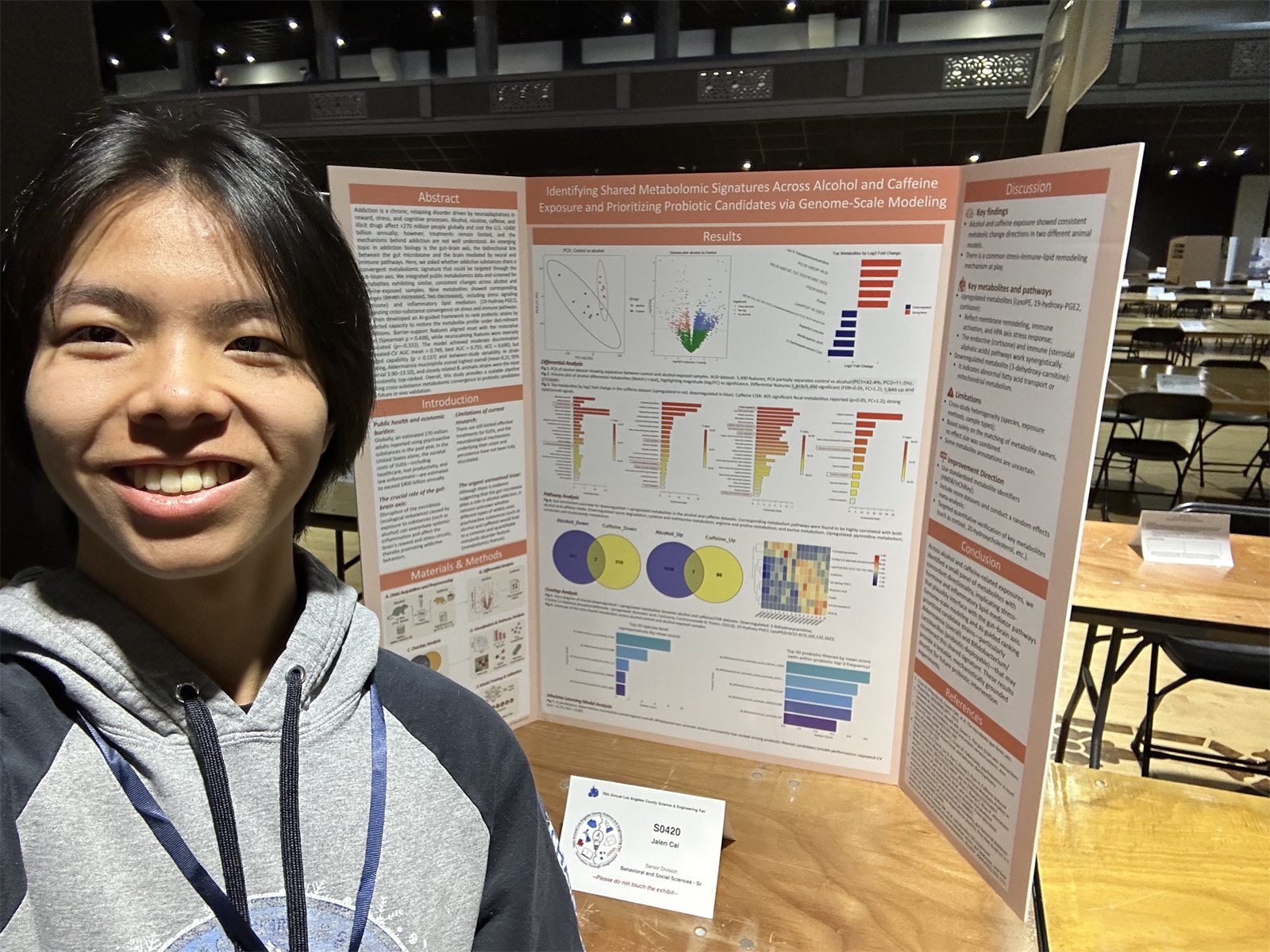
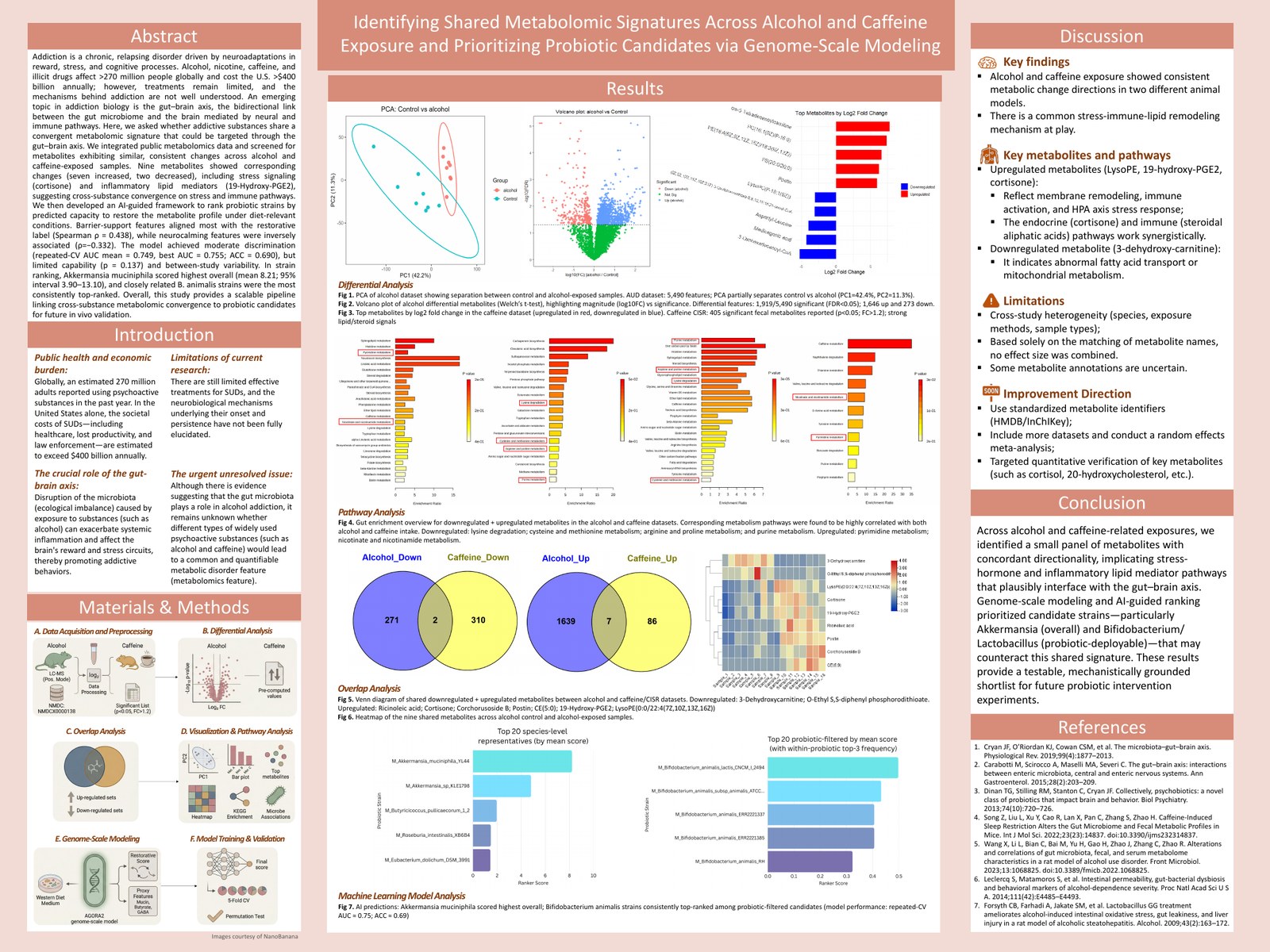
The LACSEF 2026 poster records the earlier computational stage. The September 20, 2026 manuscript draft adds the separate experimental-priority model and preliminary mouse results. Both PDFs include a reader note identifying the version and its limits.
The manuscript is a working author draft. Figure 3’s counts still need reconciliation with the feature totals in the text, and complete endpoint-specific animal statistics remain to be reported. The animal study does not validate the primary ranking or the exact top-ranked strain in the secondary model.
The question
This project asks whether biological changes linked to alcohol and caffeine exposure can be used to identify gut microbes worth testing as possible modulators of the gut–brain axis.
It starts from public fecal metabolomics datasets — one from alcohol-exposed rats, one from caffeine-induced sleep-restricted mice — and looks for metabolites and pathways that move in the same direction in both. The two studies stay separate rather than being pooled; this is a search for concordance, not a meta-analysis with combined effect sizes. From there, genome-scale metabolic modeling and a supervised ranking step cut a long list of microbes down to a short one, and a second, separate model picks a candidate practical enough to investigate in the near term. A different strain of the same species, Lactiplantibacillus plantarum HMPM2111, was evaluated in a mouse model.
The result is a computational-to-experimental framework — a way of deciding what to test first. It is not evidence that a probiotic treats anything.
Teaching an AI to search for probiotics
The ranking system began with a practical problem: a long list of possible probiotic species is not useful if there is no principled way to decide which ones deserve experimental attention first.
I combined metabolomic evidence from alcohol- and caffeine-exposure datasets with pathway-level changes and microbial metabolic models, then used those features to prioritize organisms whose predicted behavior best matched the biological signals I wanted to investigate. The goal was not to let a model declare a “best probiotic,” but to use computation as a filter.
Add a pipeline diagram or screenshot of the ranking workflowWhat came out of it
Nine metabolite annotations moved in the same direction across the alcohol and caffeine analyses. The pathways they sit in span lipid, amino-acid, nucleotide and energy-related biology rather than pointing at one tidy mechanism, which is either the interesting part or the inconvenient part depending on the day.
Ranking predicted gut–brain-relevant microbial functions puts Akkermansia at the top overall, with Bifidobacterium animalis leading the prespecified probiotic-deployable subset. These functions are indirect proxies; the model does not demonstrate restoration of all nine shared annotations. The separate experimental-priority model — the one that has to pick something testable now rather than something ideal — ranked Lactiplantibacillus plantarum ATCC 14917 first among probiotic-deployable candidates. That rank is not robust: drop the curated literature evidence, or the LP-specific evidence, and it moves. LP is the sensible place to start, not the answer.
Methods
The project uses a staged discovery, prioritization, and proof-of-concept design. I first analyzed public fecal metabolomics data from alcohol- and caffeine-related rodent exposure models, looking for metabolites and pathways altered in the same direction without pooling effect sizes across the two studies. I then used AGORA2 genome-scale microbial reconstructions and a supervised ranking framework to prioritize strains with predicted gut–brain-relevant metabolic functions. A separate experimental-priority model combined the primary computational ranking with public host-response evidence, literature, feasibility, safety, and an uncertainty penalty to choose a practical strain for near-term proof-of-concept testing. Wet-lab outcomes were deliberately excluded from the ranking inputs.
Full circle: from computer predictions to the wet lab
My first research experience was entirely experimental. Then I spent several years moving deeper into dry-lab work: transcriptomics, metabolomics, machine learning, and modeling. With this project, that path has started to loop back on itself.
The loop has now reached the bench. Lactiplantibacillus plantarum HMPM2111 was evaluated in a caffeine-exposure mouse model, using behavioral and molecular endpoints — anxiety-like and exploratory measures, and inflammatory and tight-junction-associated transcripts in the prefrontal cortex. Preliminary observations point in potentially favorable directions, but the analysis is not yet final enough for causal or therapeutic claims.
This experiment does not validate the primary ranking or ATCC 14917’s secondary rank. Direct testing of the top primary-model candidates remains future work.
Returning to wet-lab work feels less like changing directions and more like completing the circuit: experiment → model → prediction → experiment.
Where it stands
The computational pipeline is substantially complete, the proof-of-concept experiment has run, and the analysis is still being worked through. The manuscript — Shared Metabolomic Signatures Across Alcohol and Caffeine-Related Exposures and Probiotic Prioritization via Genome-Scale Modeling — was prepared for BLSME 2027 and accepted after peer review on September 25, 2026, ahead of the January 2027 conference in Jeju. The September 20, 2026 author draft is available above, with the remaining reporting gaps identified in its reader note. It is a working draft, not a publisher’s version of record.
Images, posters & documents

↳Milestones
- 2025
Teaching an AI to Search for Probiotics
A long list of possible probiotic species is not useful without a principled way to decide which ones deserve experimental attention first. This chapter is about building that filter.
Chapter- Add a pipeline diagram or screenshot
- 2026
Taking the Gut-Brain Project to the LA County Science Fair
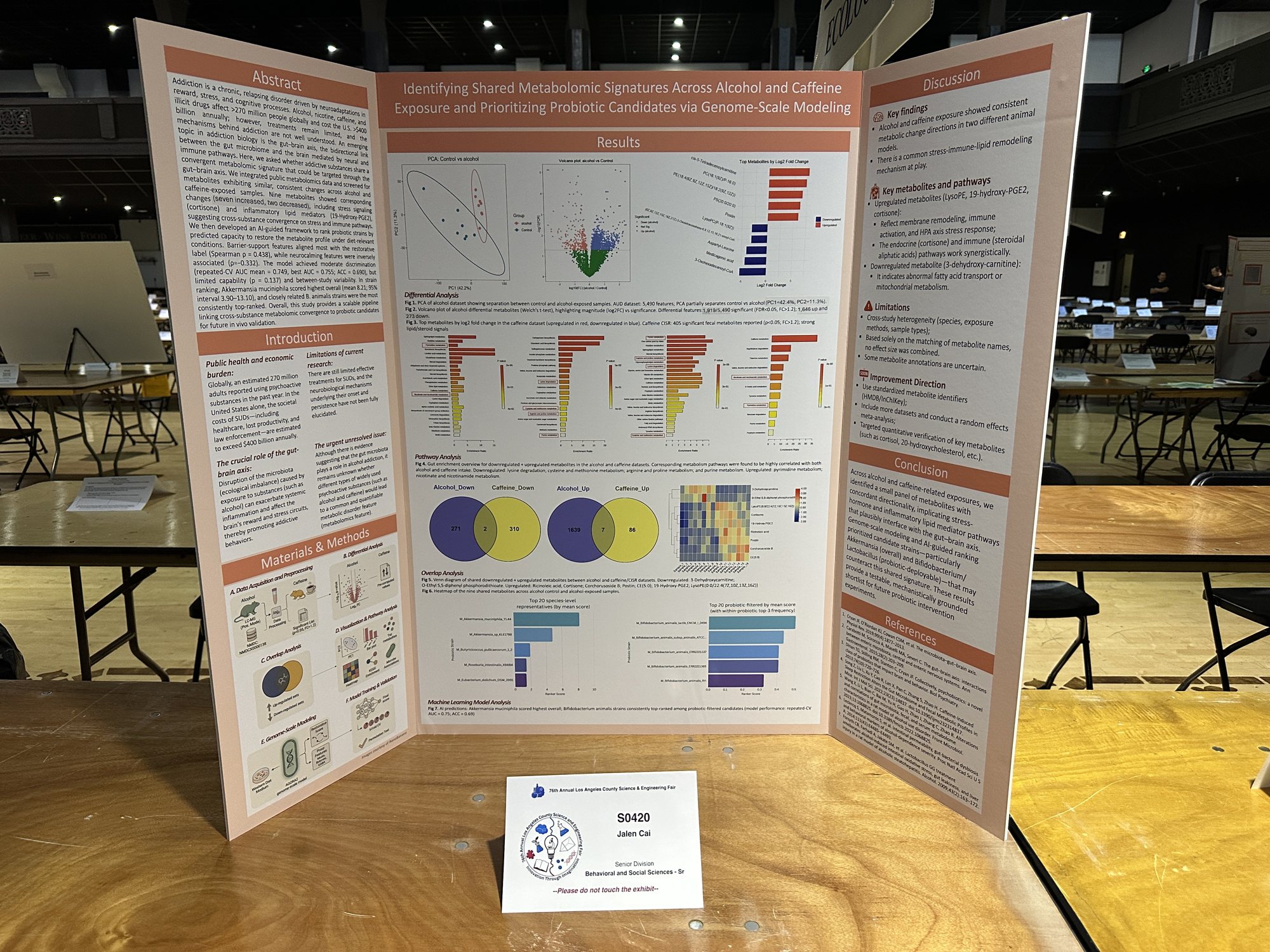
The project's first public outing: presenting the metabolomics and candidate-ranking work at the 2026 Los Angeles County Science & Engineering Fair.
★ Honorable Mention — Los Angeles County Science & Engineering FairChapter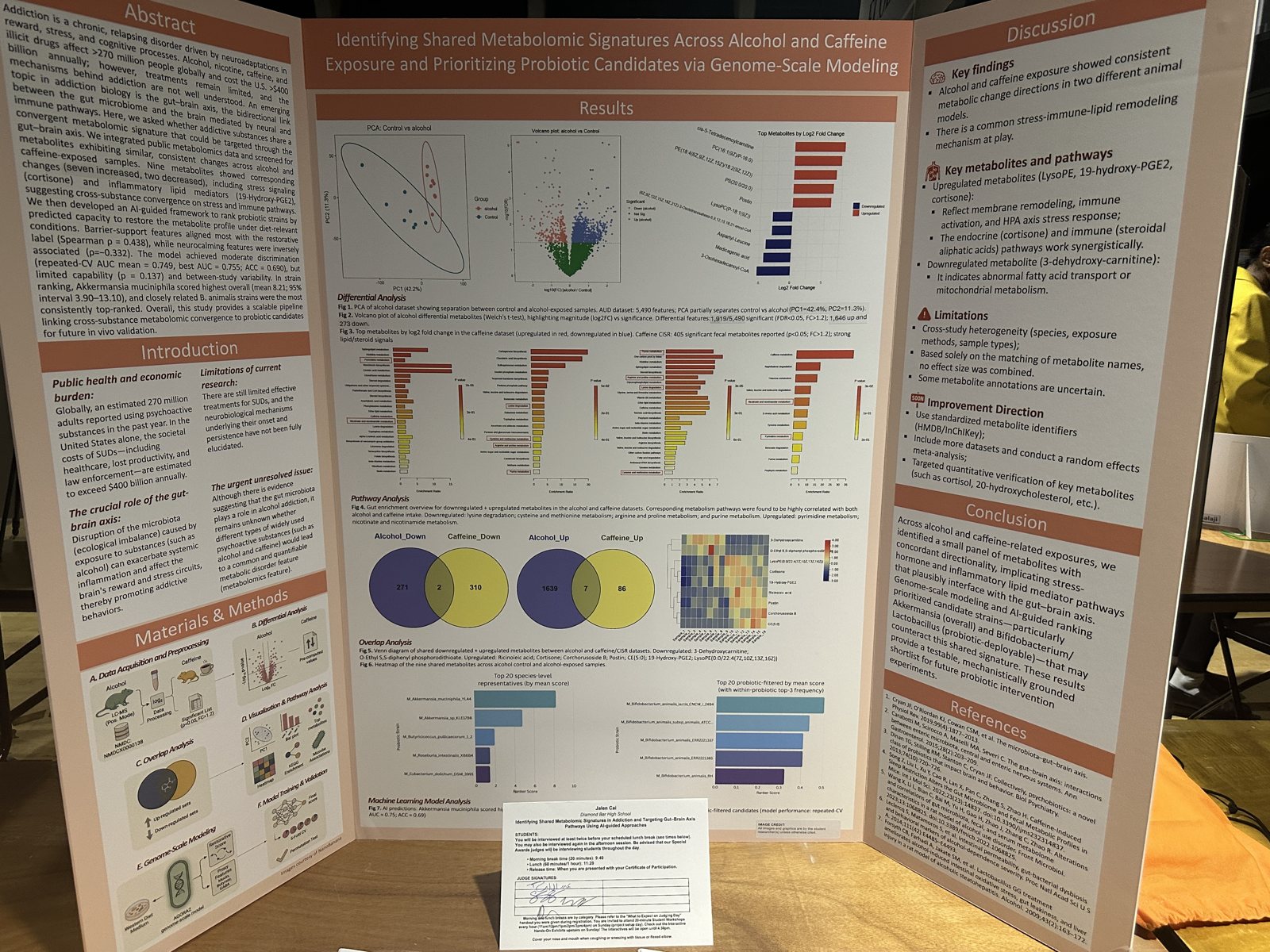
Set up and waiting for judges 
The check-in line outside the venue 
Board S0420, Senior Division 
The boba break afterwards - 2026
We've Come Full Circle: From Computer Predictions to the Wet Lab
The loop reached the bench. Lactiplantibacillus plantarum HMPM2111 was evaluated in a caffeine-exposure mouse model. It is a different strain from ATCC 14917, which led the secondary model's probiotic-deployable ranking. The analysis is still open.
Chapter- Add approved validation figure(s) once the analysis is final
- 2026
Writing It Up: Shared Signatures, Ranked Candidates
The metabolomic comparison, the ranking pipeline and the validation work pulled into one draft, "Shared Metabolomic Signatures Across Alcohol and Caffeine-Related Exposures and Probiotic Prioritization via Genome-Scale Modeling". The manuscript draft dated September 20, 2026 is available as an author manuscript prepared for BLSME 2027.
Manuscript - September 2026
Accepted to BLSME 2027
The paper (manuscript no. BLSME-6239) passed peer review and was accepted on September 25, 2026 to the 6th International Conference on Biotechnology, Life Science and Medical Engineering, held January 30–31, 2027 in Jeju, South Korea. Accepted papers are slated for the conference proceedings in Highlights in Science, Engineering and Technology (Darcy & Roy Press); it has not been published yet.
Accepted paper- Add the proceedings DOI and link once the paper is published